
What is TracePermit?
TracePermit is an open-source Agentic Visibility & Control (AVC) proof of concept. Its Java gateway attributes, classifies, authorizes, and records supported AI-agent tool actions before safe simulator execution. Real target adapters and production deployment are future work.
It allows organizations to answer the fundamental question:
"Who or what caused this action, what authority did it have, what exact operation was attempted, which policy applied, what was approved, and what outcome can be proven?"
From tool proposal to controlled execution
The model proposes an action; it does not grant authority. This overview shows the control points across supported profiles—not one launcher that combines every identity, approval, and recovery feature.
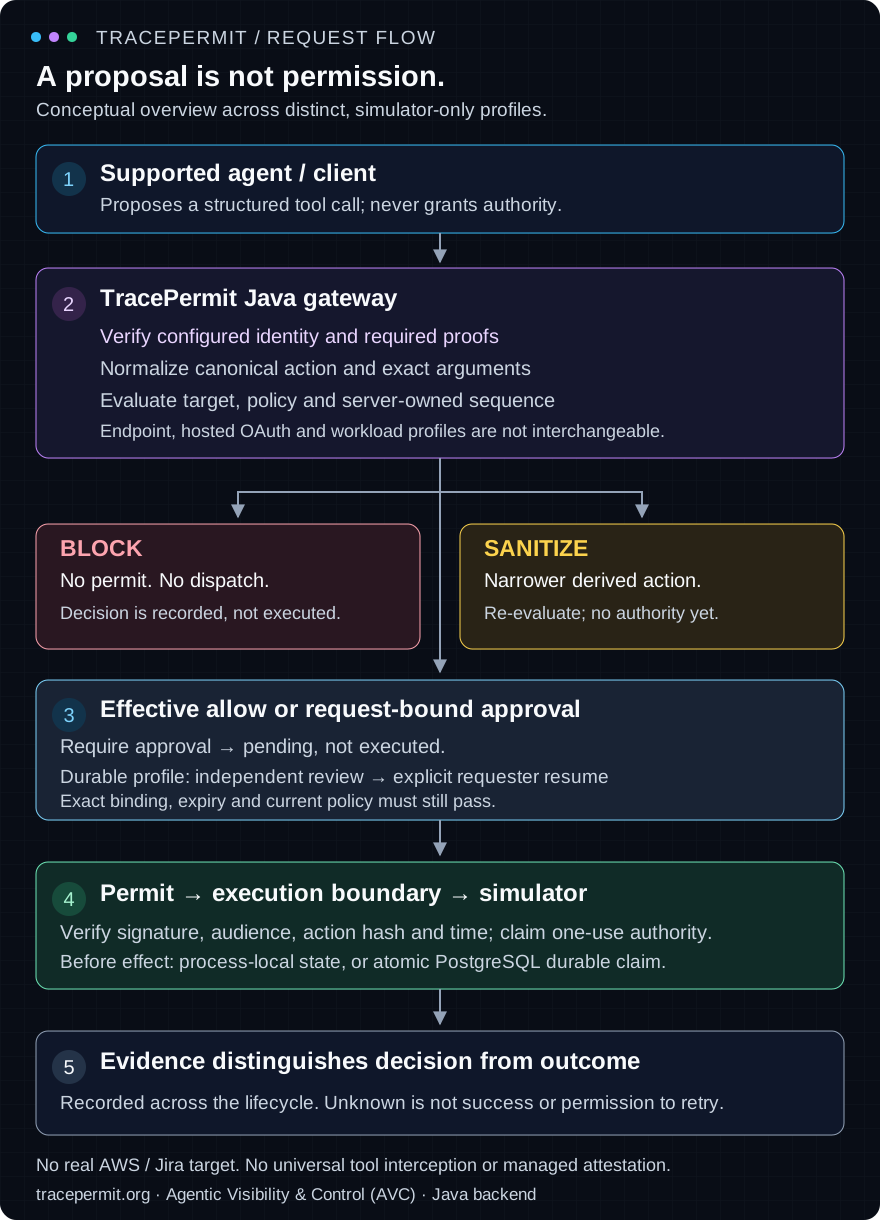
Open the request-flow SVG at full size
- Propose and verify. A supported client submits a structured tool call. The Java gateway verifies the configured identity and, where required, request-bound source or workload proofs. Local endpoint, hosted OAuth, and signed-workload profiles are distinct.
- Normalize and evaluate. Java creates the canonical action and evaluates its arguments, target, policy version, and server-owned sequence context.
- Follow the decision. Block means no dispatch. Sanitize creates a narrower action for full re-evaluation. Require approval means pending, not executed. In the durable approval profile, an independent reviewer approves an exact request; the original requester must explicitly resume it before expiry, with current policy checked again.
- Verify before effect. An effective allow can produce a request-bound execution permit. The execution boundary checks its signature, audience, hash and time, and claims one-use authority before simulator dispatch. The PostgreSQL profile atomically claims durable approval, permit and attempt state; the default local path uses process-local state.
- Record what is known. Bounded, correlated evidence distinguishes policy decisions from execution outcomes. An unknown outcome is not success and does not authorize a retry. Lookup-only reconciliation is a separately tested durable foundation, not an automatically running recovery service.
Simulator-only, not a universal interceptor
Current executable targets are simulators. The local endpoint connector connects to a backend on the same laptop; the website is documentation, not a hosted backend. Real enterprise deployment additionally needs controlled target credentials and anti-bypass egress. A source proof is not action authorization.
The Problem: Why Agents Break Traditional Security
AI agents can propose multi-step tool calls and actions, including cloud operations. The enforcement question is what executable action crosses a controlled boundary—not whether the model's private reasoning was visible.
Existing controls do not, by themselves, provide the complete action context used here:
- Prompt checks are not execution authorization: Text inspection can help detect unsafe content, but it does not replace a decision on the exact structured tool invocation and its target.
- IAM and AVC answer different questions: IAM can restrict principal, action, and resource. TracePermit adds request-bound approval, sequence context, and a simulator-side execution permit; it does not replace downstream IAM.
- Causal Lineage is Confused with Authority: A chain showing which agent called which does not by itself grant authority. The signed-workload POC independently verifies complete, narrowed delegation chains.
- Client Claims Cannot Be Trusted: Attackers can trick an agent into injecting headers (e.g., claiming to be an admin or claiming an action was pre-approved). TracePermit operates under complete mediation: never trust client-asserted security claims.
Core Pillars of TracePermit
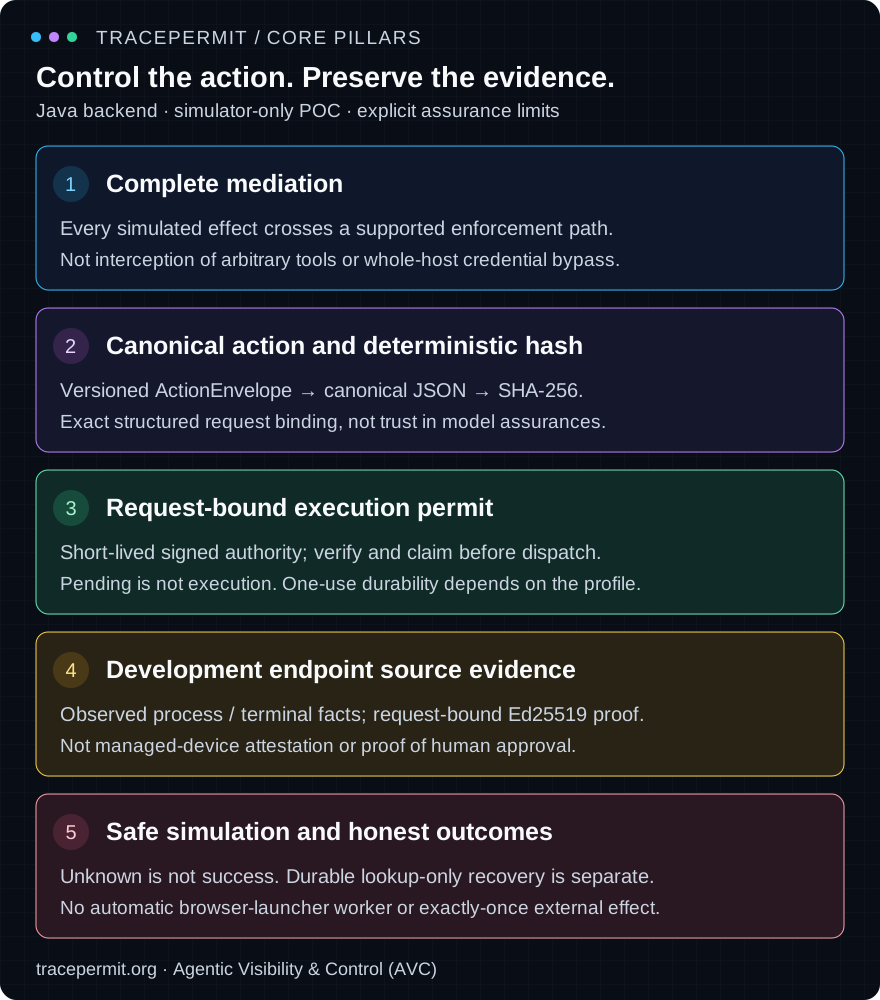
Open the core-pillars SVG at full size
- Complete mediation within supported paths. Every simulated side effect crosses an enforcement point. This does not intercept arbitrary tools or prevent whole-host credential bypass.
- Canonical actions. Java normalizes a versioned ActionEnvelope using
tracepermit-canonical-json-v1and SHA-256. Policy and permits bind to the exact structured action, not model assurances. - Request-bound execution permits. Effective allow is distinct from pending approval. The execution boundary verifies a short-lived signed permit and claims one-use authority before effect. Durability depends on the selected store/profile.
- Development endpoint source evidence. The local Java connector observes process and terminal facts and signs a request-bound Ed25519 source proof. It is not managed-device or hardware-backed attestation, or proof of human approval.
- Safe simulation and honest outcomes. AWS/Jira targets are simulated. Durable unknown-outcome handling and lookup-only reconciliation have separate tests; there is no automatic worker in the browser launcher or exactly-once external-effect guarantee.
For profile-specific wiring and limits, see the end-to-end architecture, local endpoint connector, and developer flow guide.
Next Steps
- What works today: Choose a qualified simulator profile and understand its limits.
- Fresh MacBook evaluation: Follow the clean-machine source walkthrough or the separate operator-package path.
- Local POC quickstart: Build and run the Java gateway, React console, and simulator scenarios from source.
- The Security Invariant: Deep dive into the formal trust guarantees.
- End-to-End Architecture: Explore the complete pipeline from ingress to execution.