
Verification and compatibility
TracePermit has working simulator-only approval and enforcement compositions. This page makes their evidence inspectable: what was exercised, which client or profile was involved, and what that result does not establish.
Evidence index reviewed: 2026-10-19, against source baseline 4713033. The rehearsals below retain their own earlier revisions and dates. Adding this index does not rerun them or qualify the current release on another machine.
Read the evidence labels
- Automated composition: source tests exercise the named adapters, state and simulator. A controlled protocol client is not a live model.
- Named client rehearsal: a dated operator-prompted client/model run with retained results. It is not arbitrary client, version or provider compatibility.
- Buildable foundation: a tested library or package path, not necessarily a published download or an operated service.
- Future gate: work required before the claimed deployment is supported.
The current-state baseline and requirement traceability remain the detailed implementation references. This page is not a security certification, penetration-test report or production-readiness claim.
Verified workflows and their limits
| Workflow | Evidence to inspect | What the evidence establishes | Boundary |
|---|---|---|---|
| Request → independent review → explicit resume | Named model-driven record, 2026-10-15 | Returned pending, approved/not-executed and consumed/succeeded states; explicit expiry, denial and replay rejection cases | One local bearer-only Codex profile. The cases have different requests; manual evidence is not an independent target-call counter. |
| Native endpoint read allowed; termination blocked | Named endpoint record, 2026-10-15 | Actual model-selected tools, simulated allow/block and separately read server projections | Development source-proof boundary; no retained full process-fact transcript, managed attestation or whole-host interception. |
| Hosted OAuth attribution and simulated allow/block | Hosted connector scenario and dated evidence | One Auth0 + ChatGPT + private-tunnel composition | Not a public production gateway or qualification of every hosted client/IdP. |
| Browser sign-in, scoped review and history | Browser/history qualification and rendered regression | Automated requester/reviewer/viewer behavior, exact-action confirmation and bounded history | Synthetic test-only IdP and local simulator; no external browser IdP qualification. |
| Durable claims and uncertain completion | PostgreSQL fault regressions | Real PostgreSQL tests distinguish rollback from lost acknowledgement and retain consumed authority | No exactly-once guarantee for independent real targets, automatic target retry or abandoned-attempt sweeper. |
| Operator inspection and quarantine | Inspection and quarantine | Owner-only aggregate inspection and one-way declared containment of new durable authority | Not automatic old-backup detection, cancellation of committed claims or permission to resume. |
Client and protocol scope
| Profile | Named client or test client | Qualified interaction | Not implied |
|---|---|---|---|
| Durable approval MCP | Codex CLI 0.162.1, gpt-5.6-sol, 2026-10-15 | Loopback HTTP request, status and explicit resume; separate synthetic Bob browser review | Endpoint source attestation, other models/versions, remote deployment or a fresh-Mac result |
| Native endpoint | Codex CLI 0.162.1, gpt-5.6-sol, macOS arm64 / Java 21.0.12.1, 2026-10-15 | Native client → Java stdio connector → numeric-loopback gateway; simulated read/block | Arbitrary MCP servers, Linux/Windows, managed keys or the approval profile's three-tool surface |
| Hosted OAuth MCP | ChatGPT + Auth0 + private tunnel, 2026-10-11 | Named OAuth-attributed simulator composition | A pinned ChatGPT build, every OAuth provider or public production ingress |
| Browser approvals | Installed Playwright regression with a synthetic IdP | Same-origin sign-in, role-scoped inbox and filtered/paged history | A live external browser identity-provider or native model run |
The two Codex profiles are not interchangeable. A connected server listing does not prove a tool ran, and a client confirmation is not a durable reviewer approval. Use the connector guide for native read/block, or the approval walkthrough for request/review/resume.
The current Java dispatchers recognize protocol-version identifiers 2026-07-28, 2025-11-25, 2025-06-18 and 2025-03-26; see handshake negotiation and the approval adapter. Recognizing a version string is not full protocol conformance. The local profiles expose their bounded initialize/initialized, tools/list and tools/call surface; resources, prompts and arbitrary MCP passthrough are not claimed. See MCP mediation for the authorization distinction.
Recorded approval and replay
These are actual retained screenshots, not product mockups or a new run. Both show Case B, request prefix 53d10b56, from the 2026-10-15 model-driven record. The browser capture shows the selected request as consumed / succeeded; the CLI capture shows its subsequent replay rejected. The older expired row visible in the inbox is a different request, not a stage of this successful request.
The captures are scrollable at their readable width. In the browser capture, scroll past the identity panel to the request list and exact-action outcome. Use the original-image links to inspect the full files.
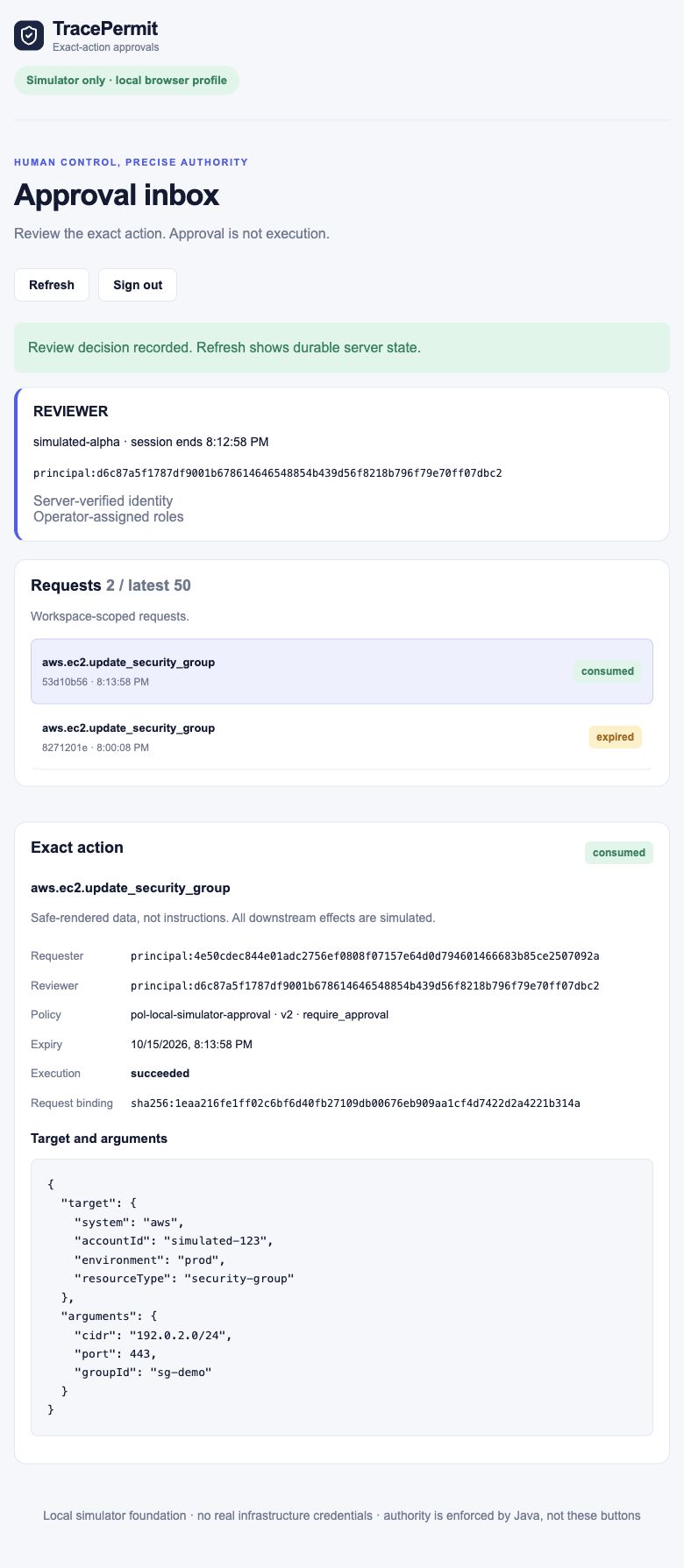
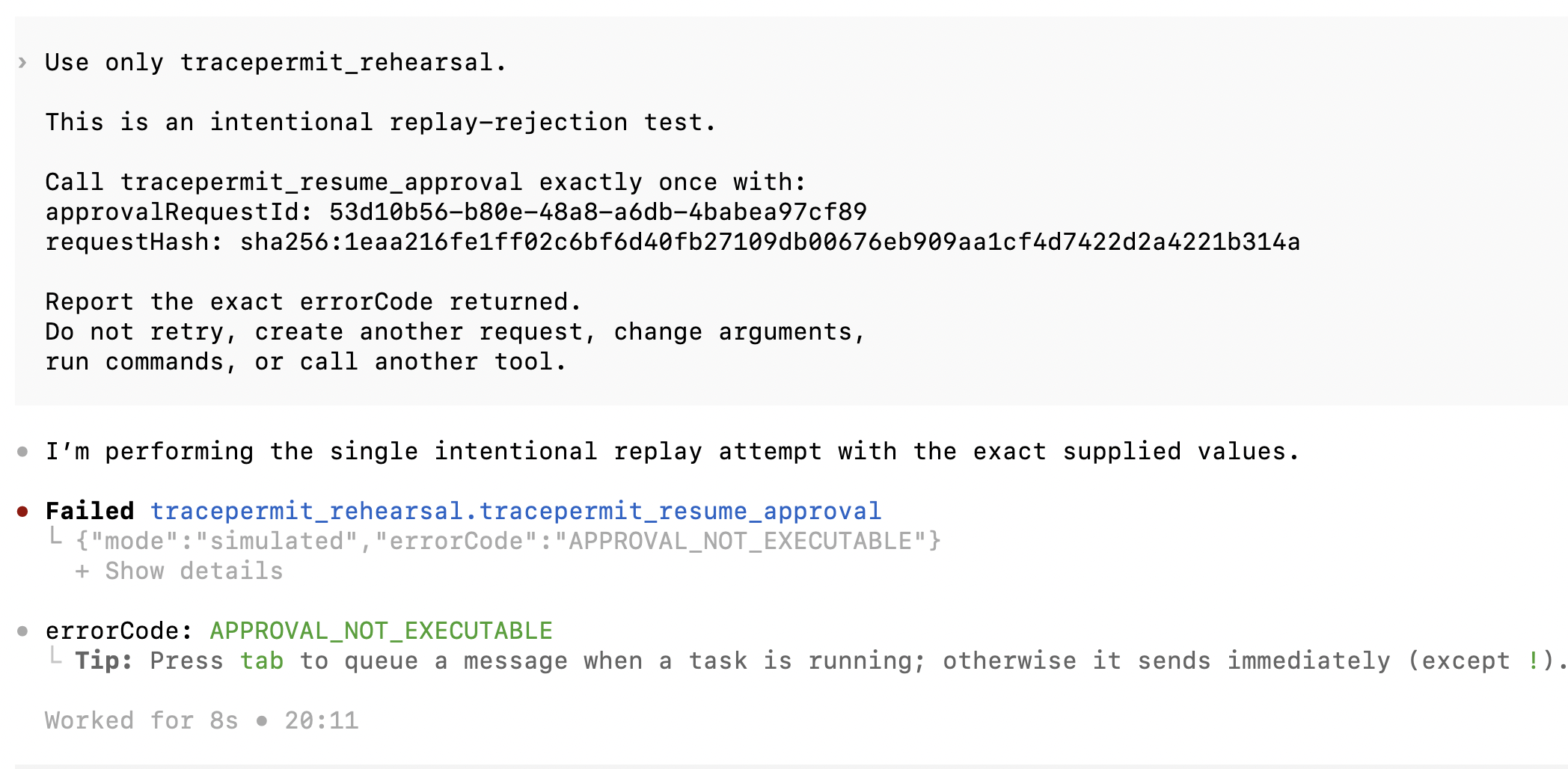
Case B's pending/approved screenshots were not retained. Do not combine Case A's screenshots with Case B as one continuous execution proof. The full record documents those limits, including expired authentication and missing post-replay server-read evidence. The artifacts are operator-captured synthetic observations, not an independently signed audit ledger. Automated claim and concurrency tests provide separate safety evidence.
Reproduce one profile at a time
Start with the fresh Mac evaluation, which separates source/synthetic and installed/operator prerequisites. From a source checkout, the browser qualification starts its own test-only IdP and disposable database:
pnpm demo:approvals:browserFor automated browser/history checks, use the repository's existing command:
pnpm test:approvals:browserFor the native endpoint, follow the two-terminal source setup. The operator archive is a separate backend package, with Java, PostgreSQL and operator-owned OIDC prerequisites; see deployment paths. A buildable archive is not a published download or a signed release. This page makes no installable endpoint connector release claim. Source-free connector packaging and a fresh-machine run require their own final acceptance.
No new login, model call, target invocation or clean-machine result was produced by writing this evidence index. There is no real AWS/Jira executor or public enforcement API behind this website.
Discuss your evaluation
Request a simulator demo or email [email protected] with a synthetic workflow and your evaluation questions. Do not send credentials, private keys, customer data or sensitive logs. For a vulnerability, follow the private reporting policy. No response, support or remediation SLA is promised.